Three chai breaks today. Zero workouts this week.
Somewhere between the Slack notification that arrived while the chai was still brewing and the meeting that ran forty minutes over, the plan quietly died again.
That's not failure. That's just Tuesday.
Everyone knows this cycle. Nobody talks about it honestly.
Sunday evening, full resolve. New plan. Maybe a new app downloaded. Alarm set for 6 AM. Bag packed the night before like that's going to make the difference this time.
Monday is decent. Tuesday is okay. By Wednesday the alarm gets snoozed, Thursday there's an actual reason, Friday you're running on empty, and Saturday somehow becomes the unofficial rest day nobody planned.
Then Sunday. Same resolve. Same cycle.
Kal se pakka is not laziness. It is optimism that keeps restarting.
But at some point the cycle just gets exhausting. Missing a workout starts to feel like a character flaw — like something is wrong with you specifically, not with the routine you picked. So people quietly stop trying. Not because they stopped caring, but because trying and failing on repeat is its own kind of tired.
Most fitness content skips this part. It goes straight to the plan.
The opinion nobody in Indian fitness wants to say clearly
Indian fitness culture spent years selling intensity to people who just needed consistency.
We idolise the 5 AM crowd. We share transformation videos. We say "no days off" like it's a personality. And the message that crept in, slowly, was this: if it isn't hard and regimented and at least a little miserable, it probably doesn't count.
Most people don't need a harder workout.
They need one that survives a Tuesday.
That is a completely different problem — and it has a completely different solution.
Your gym plan isn't failing you. The schedule it was built for doesn't exist anymore.
Work-from-home sounded flexible until your office somehow entered your bedroom, your dining table, and most of your weekends too.
The pressure cooker goes off mid-call. Someone's asking about lunch while you're presenting. Your "home office" is a corner of a room where the line between work and everything else dissolved sometime in 2021 and never fully came back.
At least in a physical office, you got up. Walked to the pantry. Had a pointless five-minute chat about weekend plans with a colleague you mildly tolerate. Refilled your water bottle. That movement counted — more than you realised.
For those who still commute — the Bengaluru traffic, the Gurgaon Metro at 9 AM, the Mumbai locals — you arrive already spent. The idea of a workout after that isn't laziness. It's physics.
The one-hour gym slot sounds realistic on Sunday. But your life doesn't run on Sunday logic.
The habit that was hiding in plain sight
You make chai two, three, sometimes four times a day. Each time, there's a natural pause — two to four minutes where you're just waiting, standing, doing nothing particularly useful.
You've had three chai breaks today. You already had three workout opportunities.
The practice is called fitness snacking — short bursts of movement distributed through your day instead of one concentrated block. The research is encouraging: several short activity bursts across the day can deliver cardiovascular and metabolic benefits comparable to a single continuous workout, and studies of short-bout exercise have reported adherence rates above 90% — not because people are more disciplined, but because it actually fits.
And the best anchor for it, in India, is already built into your day. Some of the longest walks Indians take daily are still "chai pe chalte hain" walks.
Why chai, specifically
Habit stacking is simple: attach something new to what your brain already does on autopilot. You don't build from zero — you borrow momentum from an existing habit.
The chai break is your anchor because it is the one pause in the Indian day that is genuinely protected. Nobody cancels chai. Not your manager. Not the deadline. Not the relatives who arrive unannounced at six in the evening. It happens whether you're in a Bengaluru co-working space, a bank in Jaipur, or your own flat in Nagpur.
The movement just attaches to it.
Picture this scene
Kettle whistling on the stove. Laptop screen glowing in a dim room. Parle-G packet open on the side — two biscuits dunked, maybe three. Body completely still for the fifth straight hour.
Half of India is in this exact scene right now. And the chai break, the one moment of natural pause in the day, is being spent completely horizontal.
Keep the biscuits. Change what happens while you wait.
The Chai Break Workout: your four-break framework
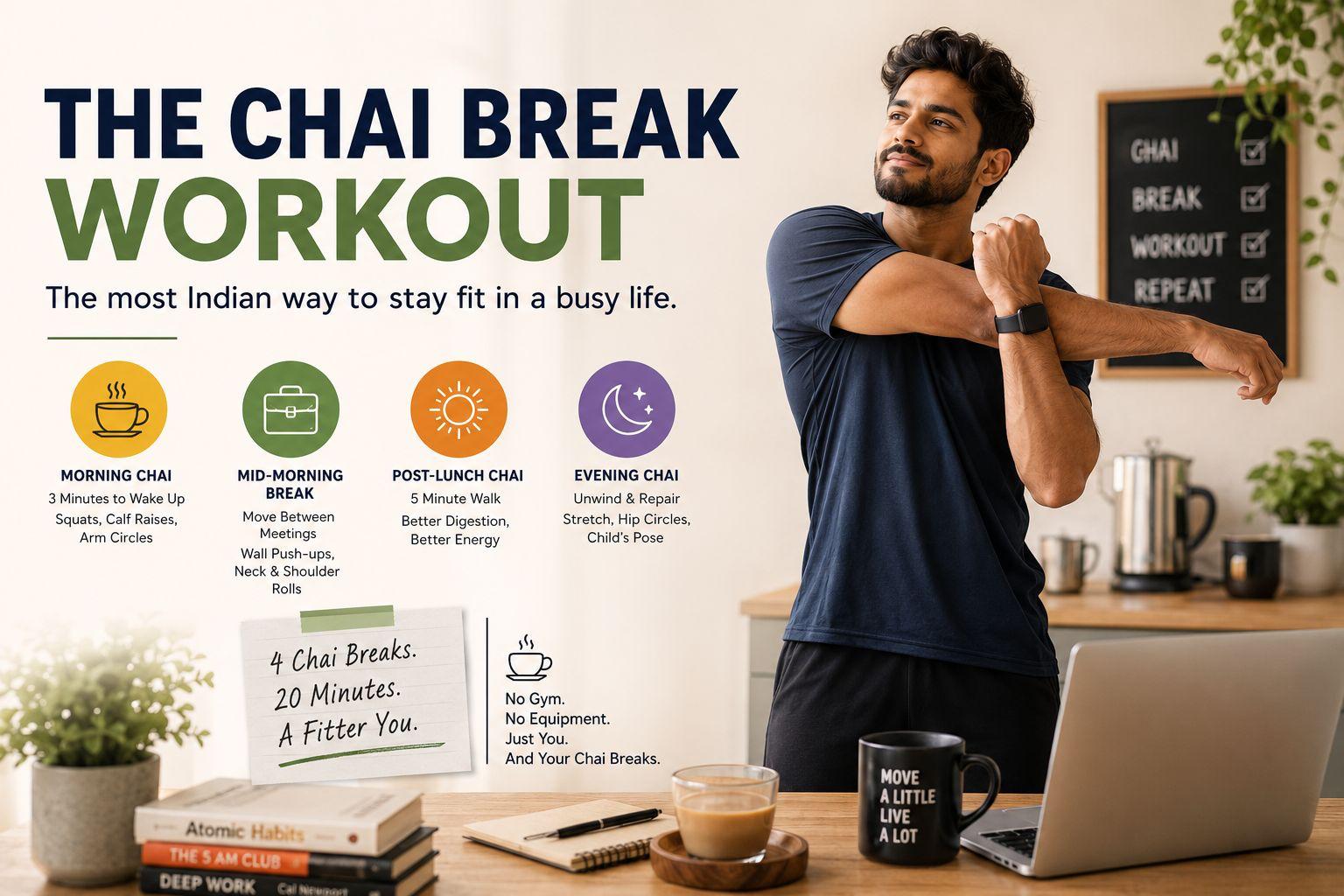
Four chai breaks. Four tiny windows. Here's what goes in each one — no gym, no equipment, no changing your clothes.
10 squats · 10 calf raises · 30 sec arm circles. A signal to your body that today is a moving day.
10 wall push-ups · neck & shoulder rolls. Break up the long sit before it breaks your back.
A 5-minute walk. Blunts the post-meal sugar spike and kills the 3 PM slump.
Child's pose · slow hip circles · a quad stretch. Undo what the chair did all day.
Morning chai — three minutes, nothing more
While the water boils: ten squats, ten calf raises, thirty seconds of arm circles.
This is not a workout. It is a signal — you telling your body that today is a moving day. After eight hours of sleep, your joints are stiff and your circulation is slow. Three minutes changes how you feel by eleven.
Mid-morning break — the one that matters most for your long-term health
Sitting for long, unbroken stretches does slow, real damage — back, circulation, blood sugar, all of it. The office pantry has witnessed more fitness conversations than most gyms in India. Next time you're there, do ten wall push-ups while the chai pours. Nobody will judge you. Some will quietly start doing it too.
Post-lunch chai — stop wasting this slot
The 2–3 PM slump is biology, not weakness. A short walk after a meal helps blunt the post-meal blood sugar spike — especially relevant for Indians, who carry a higher genetic predisposition toward insulin resistance that most fitness content conveniently ignores.
Your mom has been saying "khana khake thoda chal" your entire life. She was your first fitness coach. You just weren't listening.
Evening chai — less workout, more repair
After a full day of sitting, your hips are compressed, your lower back is tight, and your posture has been slowly collapsing since two in the afternoon.
Child's pose. Slow hip circles. A quad stretch. That's it. Not to get fitter tonight — just to undo what the chair did today, so tomorrow doesn't start in pain.
The real numbers
Four chai breaks. Roughly twenty minutes of total movement, spread across the day.
No gym. No equipment. No special clothes. No commute to a facility. No guilt when the 6 AM alarm gets snoozed because you have a 7 AM call.
It works in a 1BHK in Nashik the same way it works in a co-working space in Hyderabad. It works for the student on a UPSC prep grind at midnight and the developer two commits away from a release. It works on the days your schedule is clean and on the days everything goes sideways.
The best fitness habit is the one that doesn't need perfect conditions to happen.
How to actually start without ruining it
One snack. Just the morning one.
Tomorrow, while your chai brews: ten squats. Every day this week. Nothing else yet.
Next week, add the post-lunch walk. The week after, add the mid-morning break.
By week three, you have a full daily movement practice — built on top of what your day already does, not carved out of time you don't have.
Chai break workout: quick questions, quick answers
Can you really stay fit without going to the gym?
For building a baseline of daily movement, yes. You don't need a gym to break up long sitting, loosen stiff joints, or get your steps in — short bursts of bodyweight movement spread through the day do that work. A gym helps when you want to progressively add load and build serious strength. The chai-break habit is what keeps you moving on the 90% of days a structured gym session never happens.
What is fitness snacking, and does it actually work?
Fitness snacking means breaking exercise into short bursts — two to five minutes at a time — spread across your day, instead of one long block. Research suggests these short bursts can deliver cardiovascular and metabolic benefits comparable to a single continuous workout, and people stick with them far more reliably because they fit into a normal day.
How much exercise do I need if I have a desk job and work from home?
The bigger risk with desk work isn't too little exercise — it's too much unbroken sitting. Standing up and moving for a couple of minutes every hour matters more than one perfect workout. Four short movement breaks a day — roughly twenty minutes total — is a realistic, sustainable starting point for most people.
What are the best exercises to do during short work breaks?
Squats, calf raises, and arm circles while your chai brews; wall push-ups and neck-and-shoulder rolls between meetings; a five-minute walk after lunch; and a few stretches in the evening. No equipment, no setup — just movement that fits the pause you already take.
The thing worth remembering
Consistency built on small, sustainable things always outlasts discipline built on big, dramatic ones.
The best fitness routine isn't the most optimised one, or the one the fitness influencer is doing. It's the one that fits between your chai and your deadline — the one that actually shows up every day without turning your life upside down to make space for it.
Maybe fitness doesn't need another extreme challenge. Maybe it just needs to fit between two chai breaks.
But a habit isn't a goal. Chai-break movement keeps you consistent — when you actually want to lose the weight, fix the back that desk work wrecked, or get genuinely stronger, that's the point where a coach earns their place. Not a gym across town with hours that don't fit your day, but someone who builds a plan around the schedule you already have. That's the part we obsess over at FitAstra: matching you with a coach who works with your real life, not the one you keep promising yourself on Sunday.
Start with the chai break. When you're ready to go further, your coach is one tap away. And your chai is already brewing.

Written By
Rhytham Choudhary
Intern @ FitAstra. Works on content planning, execution, and managing communication across social platforms.